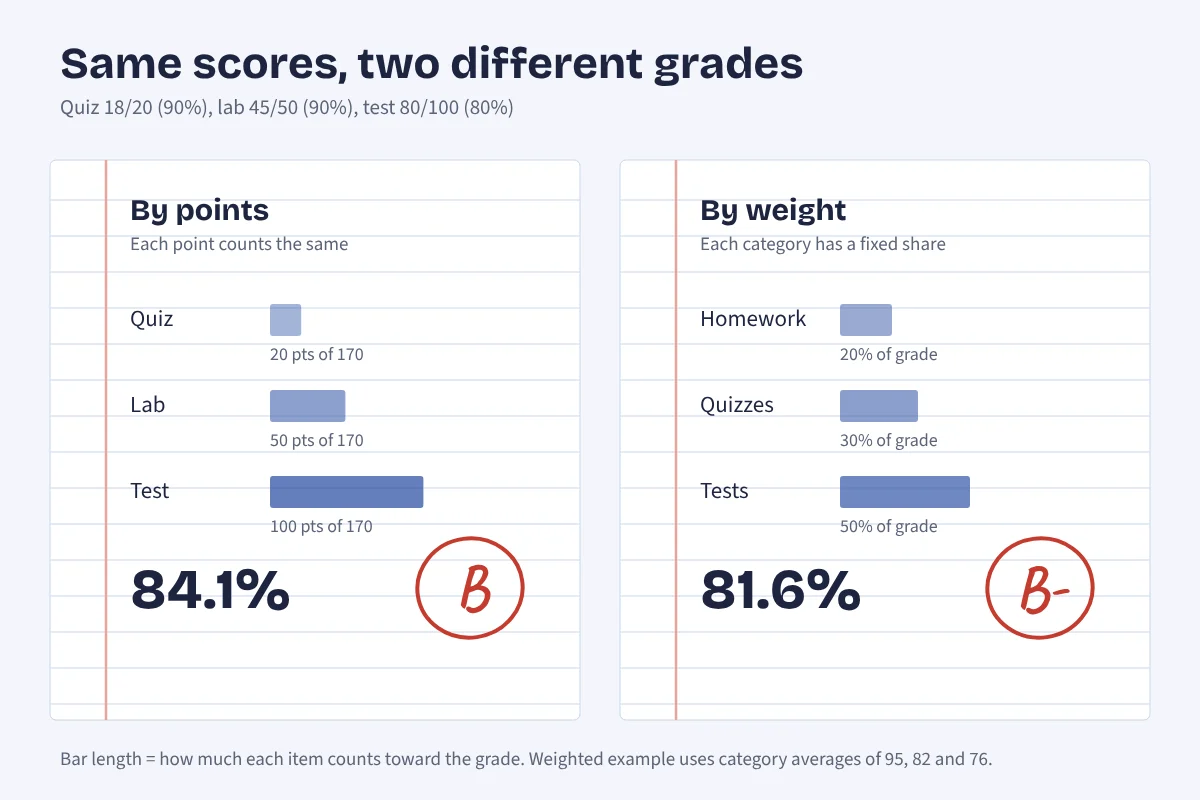
Teachers calculate grades in one of two ways: by total points or by weighted categories. The same scores can give different grades depending on which one your class uses, so the first step is finding out which.
How to tell which your class uses
Look at your syllabus or your school’s online gradebook.
- Points-based: the syllabus lists assignments by points (“Unit test, 100 points”) and your gradebook shows a running total like 143 / 170.
- Weighted: the syllabus lists categories with percentages (“Tests 50%, Quizzes 30%, Homework 20%”), and the gradebook shows an average for each category.
Points-based grades
Every point counts the same. Add up what you earned and what was possible, then divide.
Grade = points earned ÷ points possible × 100
Example: 18 / 20 on a quiz, 45 / 50 on a lab and 80 / 100 on a test.
- Points earned: 18 + 45 + 80 = 143
- Points possible: 20 + 50 + 100 = 170
- Grade: 143 ÷ 170 × 100 = 84.1%
Bigger assignments matter more simply because they have more points. Here the 100-point test counts five times as much as the 20-point quiz.
Weighted grades
Each category is worth a fixed share of the grade, however many points are in it.
Grade = Σ (weight × category average) ÷ Σ weight
Example: say those scores sit in categories weighted homework 20% (95% average), quizzes 30% (82%) and tests 50% (76%).
- Homework: 0.20 × 95 = 19.0
- Quizzes: 0.30 × 82 = 24.6
- Tests: 0.50 × 76 = 38.0
- Grade: 19.0 + 24.6 + 38.0 = 81.6%
The weighted grade calculator does this for any number of categories.
Why the two methods give different answers
In a weighted class, a category with a few big assignments and one with lots of small ones can be worth exactly the same. If your weakest category carries the most weight, your grade will sit below your plain average of scores. That’s the most common surprise when a report card arrives.
When a category isn’t graded yet
Early in a term, a category like the final exam has no score. Gradebooks usually leave it out and divide by the weight that has been graded. With homework 20% (95%), tests 60% (80%) and the final 20% not yet taken, your grade so far is:
(0.20 × 95 + 0.60 × 80) ÷ 0.80 = 67 ÷ 0.80 = 83.75%
That’s the number your gradebook shows now. What happens on the final is a separate question, covered in what do I need on my final?
Rounding and letter grades
Your percentage turns into a letter using your school’s scale. On the common A+ to F scale, 84.1% is a B and 81.6% is a B-. Some teachers round 89.5% up to 90%, and some don’t. See the grading scales page for the usual cutoffs.
Quick checklist
- Find out whether your class is points-based or weighted.
- Use your scores exactly as the gradebook shows them, before rounding.
- Include zeros for missing work. They count.
- Check extra credit: some teachers add it to points earned, others to a category.